
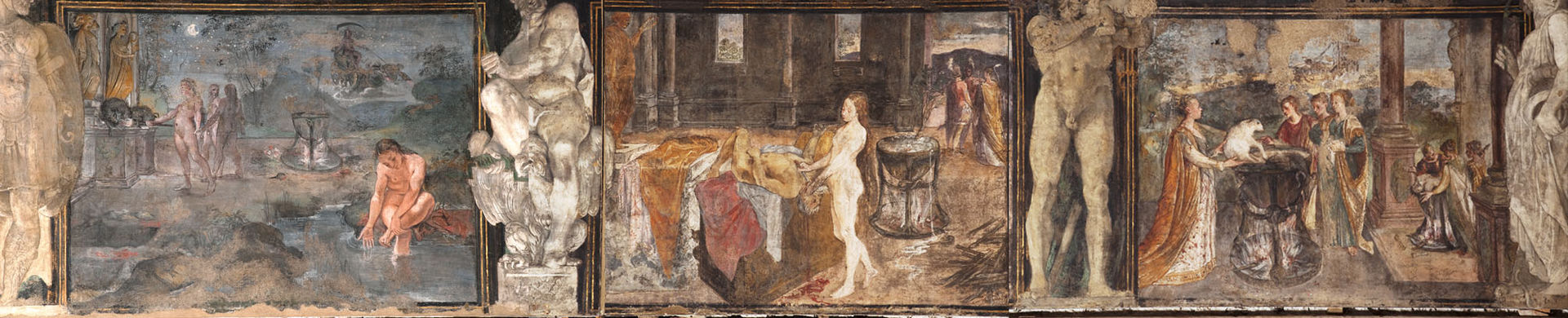
At Palazzo Fava, the Carracci worked together for the first time on a frieze decoration. This decorative system, typical of noble residences, was very popular in Bologna, where numerous examples still exist today. Many of the most famous artists from Bologna’s previous generations worked on this type of decoration: among them, Nicolò dell’Abate, a true specialist in the genre, and Pellegrino Tibaldi stand out.
The frieze system consists of creating a painted band placed immediately below the ceiling of a room, which extends without interruption along the entire perimeter of the space. This band is divided into panels, areas intended to host the theme, separated by architectural elements that distinguish each one from the other. Thanks to this structure, the frieze is particularly well-suited to tell a story, with the various episodes distributed, according to the narrative order, in the panels separated by the architectural elements. The themes chosen were usually historical events (such as the deeds of Alexander the Great or ancient Roman heroes) or literary themes, either ancient (such as stories from the Aeneid or the Odyssey), or modern (such as the chivalric deeds of Ariosto). Mythological themes were rarer, like those painted by the Carracci in Palazzo Fava.
Regarding the choice of the Jason and Medea theme for the frieze, it was not accidental that the same subject had already been dealt with in the decoration of another property of the Fava family (no longer extant) by Pellegrino Tibaldi. From this, it was inferred that the Fava family regarded the Argonauts’ story as having a particular significance, probably related to their study and practice of medicine, a science that, like the stories of the Argonautica, contains several allegorical connections, including Medea’s magical arts, which are the most immediate.
The frieze is composed of eighteen panels, depicting the events of the conquest of the golden fleece, interspersed with twenty-two monochrome deities, which serve as dividers between the various episodes. The iconographic source for these deities is Vincenzo Cartari’s Imagini de i Dèi delli Antichi, a famous 16th-century publication, reprinted several times. For some of the monochromes, stylistic derivations from sculptural examples—both ancient and contemporary—have been identified. These derivations mainly refer to the male deities depicted in the cycle, while no similar borrowings are found for the female deities. For the latter, however, given the recurring heavy drapery covering them (except for Venus), it is believed that these are based on a common iconographic type, with the most significant example being the statue of the Muse Melpomene preserved in the Louvre. As Carlo Cesare Malvasia observed in Felsina Pittrice (1678), the deities that act as dividers are thematically related to the narrative scenes they enclose.
The story of Jason unfolded on a sopra-camino (a kind of over-mantle painting), now lost, which depicted the killing of Creusa, the daughter of the king of Corinth, Creon. Jason had fallen in love with her and intended to repudiate Medea for her. In revenge, Medea gave Creusa an enchanted dress that, once worn, released poison (or, according to another version, caught fire), causing the death of the Corinthian princess. The room in Palazzo Fava housing the frieze has a rectangular plan: five panels are distributed along the long walls, and four on the shorter ones. Each wall tells a chapter of the entire story.
- The first section concerns the events that precede the expedition for the golden fleece.
- The second is dedicated to the adventures of the Argonauts on their journey.
- The third narrates the events that take place in Colchis, the distant land where the fleece is located.
- Finally, the fourth section describes the events that unfold in Iolcus, upon Jason’s return home, accompanied by Medea.

