
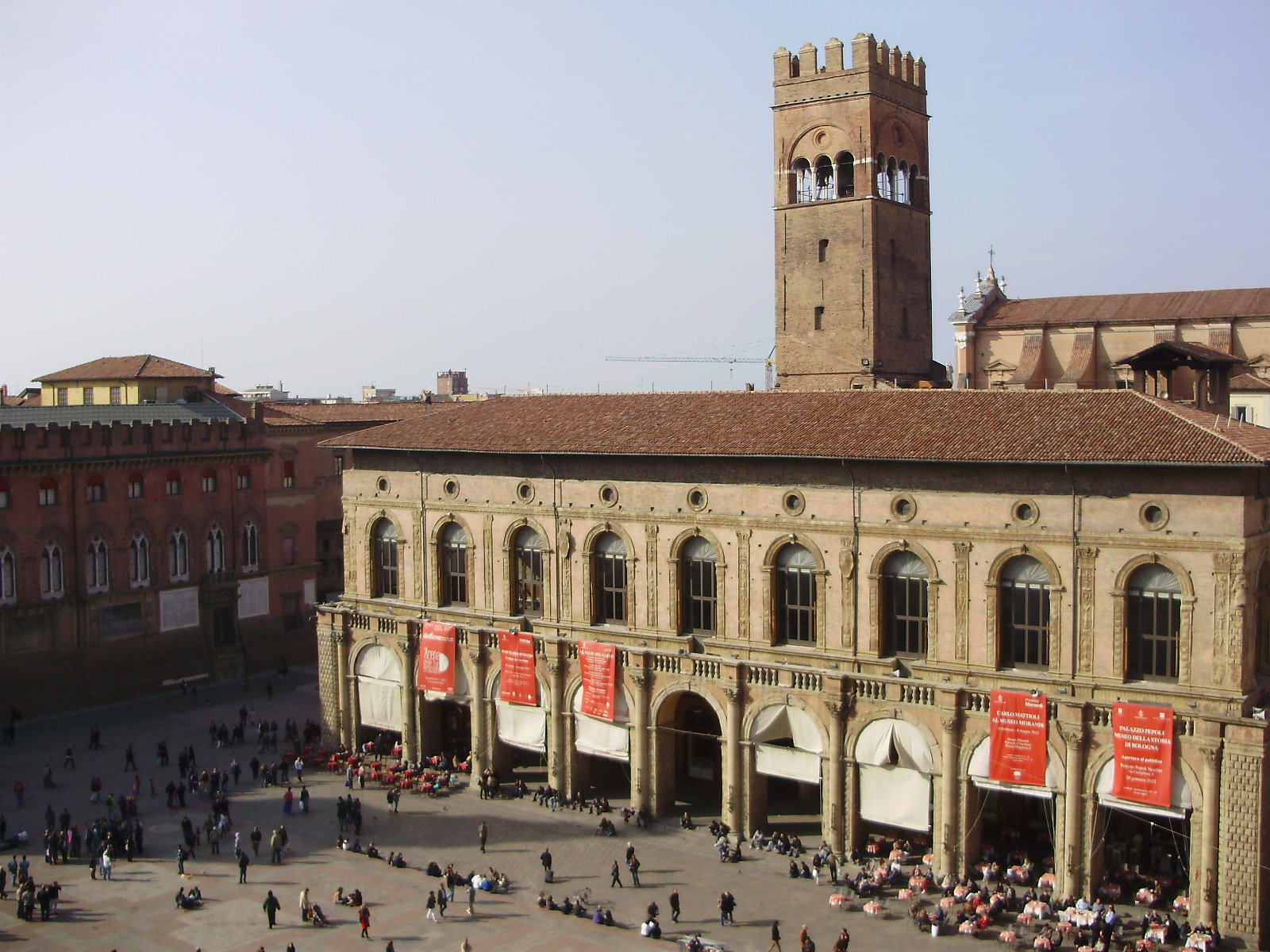
The Palazzo del Podestà in Bologna is an architectural masterpiece with a long and complex history, closely tied to the evolution of the city and its governance. Its construction dates back to the 13th century (around 1200), and it was designed to serve as the seat of civic authority and justice. Completed alongside Piazza Maggiore, the palace was meant to house the podestà and his officials, who held executive and judicial power over the city.
The building underwent numerous changes and expansions over the centuries. Palazzo Re Enzo, for instance, was built between 1244 and 1246 to imprison Enzo, the son of the King of Sardinia, who became a symbol of Bologna’s power.
The current appearance of the Palazzo del Podestà is quite different from the original, also due to the later construction of the Torre dell’Arengo in 1259. This square tower, built by Alberto di San Pietro, replaced an earlier wooden structure from 1212. Its bell—known as the Campanazzo—was installed by Aristotile Fioravanti in 1453. Fioravanti also redesigned the palace’s façade in the Renaissance style, commissioned by the ruling Bentivoglio family. However, the project was never completed due to the family’s expulsion from Bologna.
The Palazzo del Podestà is not only a monument of great historical and artistic value, but also a symbol of Bologna itself. Its transformations—from the seat of communal power to a theater and, finally, to a place that celebrates the city’s heritage—reflect the political, social, and cultural shifts that have shaped Bologna over the centuries. Together with Palazzo Re Enzo and other historic buildings, it continues to tell the story of Bologna at the heart of its public life.
The Palazzo is also notable for its floral decoration. The entire lower section is adorned with hundreds of floral tiles (formelle), each one unique. In addition, the Torre Lambertini, visible from Via Rizzoli, is another distinctive feature of this architectural ensemble—an enduring reminder of the medieval towers that once defined Bologna’s skyline.

