
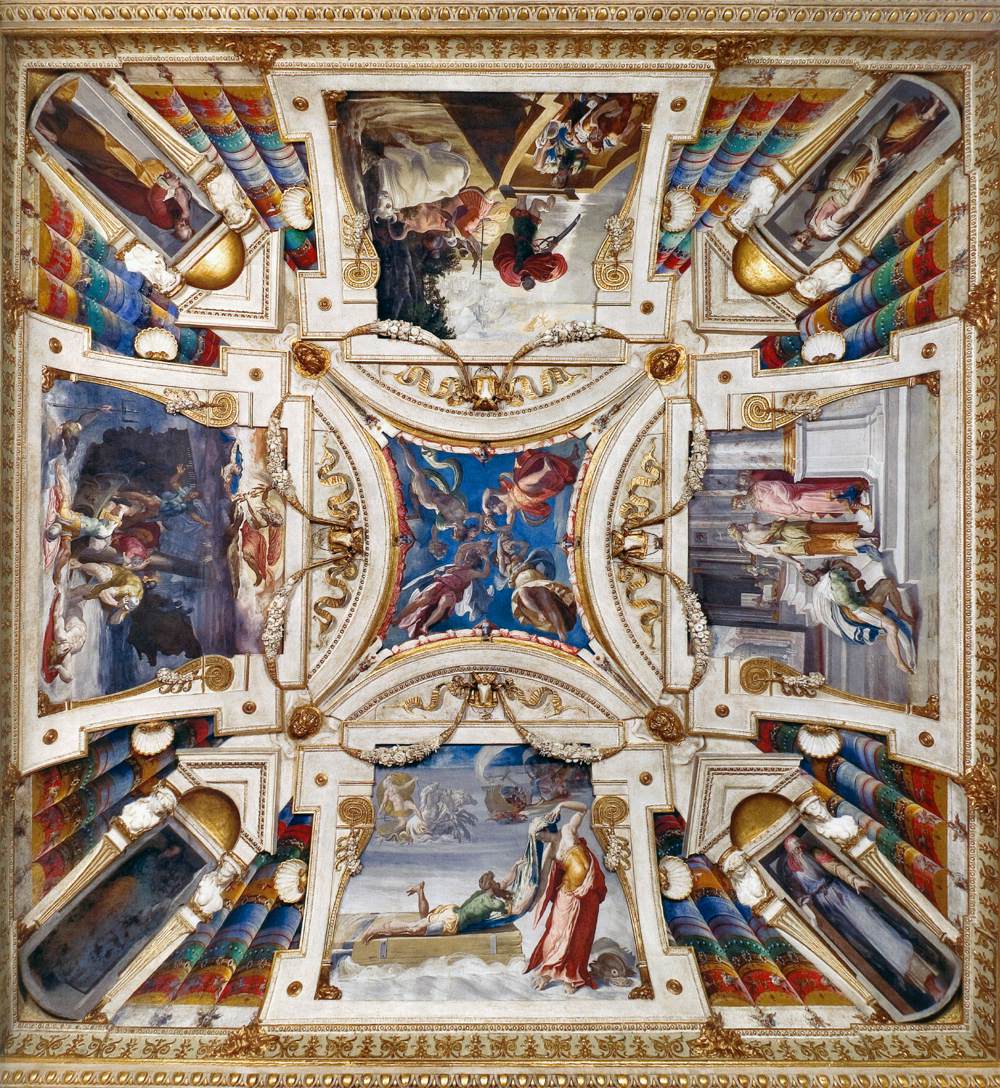
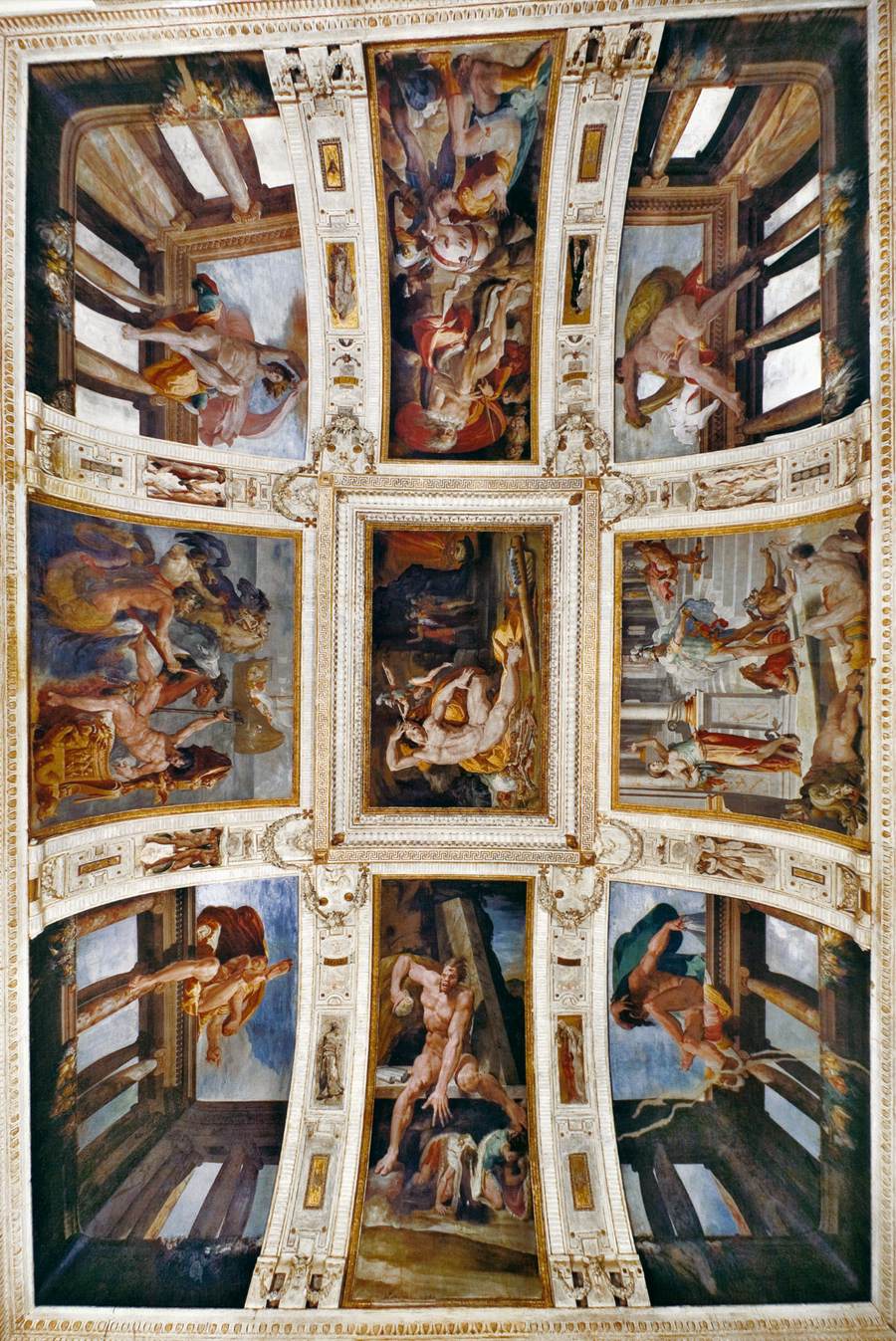
In his palace in Bologna, Cardinal Giovanni Poggi (1493–1556) commissioned the decoration of the main floor’s rooms by Niccolò dell’Abate, Prospero Fontana, and other artists. They created friezes with landscapes and grotesques, as well as numerous scenes from the Old Testament. On the ground floor, a 23-year-old Pellegrino Tibaldi painted the Ulysses frescoes, a monumental work that he would never surpass in scale or ambition.
The Ulysses frescoes decorate the vaulted ceilings of two rooms. From the entrance corridor of the palace, one first enters a large room (Sala di Ulisse), where the pictorial cycle begins. It then continues and concludes in a smaller adjacent space (Stanza di Ulisse). The ceiling layout and scene arrangement were inspired by a renowned Roman model: Raphael’s Loggias in the Vatican Palace. The scenes are presented as quadri riportati—paintings within the fresco that are framed and composed to simulate a natural perspective. Between the narrative episodes are illusionistic views of colonnades that seem to rise toward the sky, while the frames are made of stucco.
Each room features a distinct decorative system, tailored to its size and spatial context. The ceilings of the Sala di Ulisse and the Stanza di Ulisse contain five and four episodes, respectively, drawn from the adventures of Ulysses.

