Via Antonio Di Vincenzo
The street runs from Via de’ Carracci to Via Camillo Procaccini and on April 16, 1909, it was named Via Antonio Di Vincenzo, in memory of the famous Bolognese architect.
The Works of Antonio Di Vincenzo:
Antonio Di Vincenzo
It is believed that he was born in Bologna around 1350; little is known about his activities before the major project related to the Basilica di San Petronio, but the high offices he held in 1384, when he was elected gonfaloniere del popolo, and in 1387, when he was appointed gonfaloniere di giustizia, testify to his well-established reputation.
Around the age of thirty, in 1382, he was called upon to serve the Commune for military works. In 1383, he worked on the fortress of Cento, and later in Bologna, at Porta Saragozza. In 1384, he led the construction of the stretch of walls from Porta San Mamolo to Porta Pratello; in the same year, as gonfaloniere del popolo, he was entrusted, together with Lorenzo da Bagnomarino, with the works for the Loggia della Mercanzia, a project that was later carried forward solely by Lorenzo.
In the Palazzo dei Notai, which had started its oldest part in 1381 under the direction of Berto Cavalletto and Lorenzo da Bagnomarino, he designed the windows overlooking Piazza Maggiore. In 1385, he worked on the fortifications of the castles in the countryside towards Imola; in 1386, he erected the “bastia di S. Procolo” near Faenza and built some rooms in the Palazzo di Re Enzo destined for the “Camera degli Atti,” i.e., the public archive; in 1387, he continued the work at the fortress of Cento, and the next year, he rebuilt the collapsed walls around the fortress of San Giovanni in Persiceto.
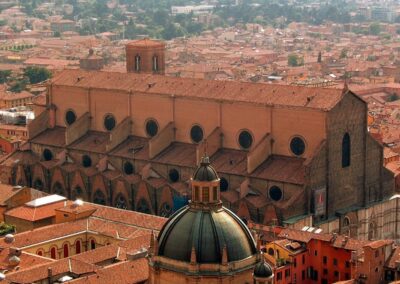
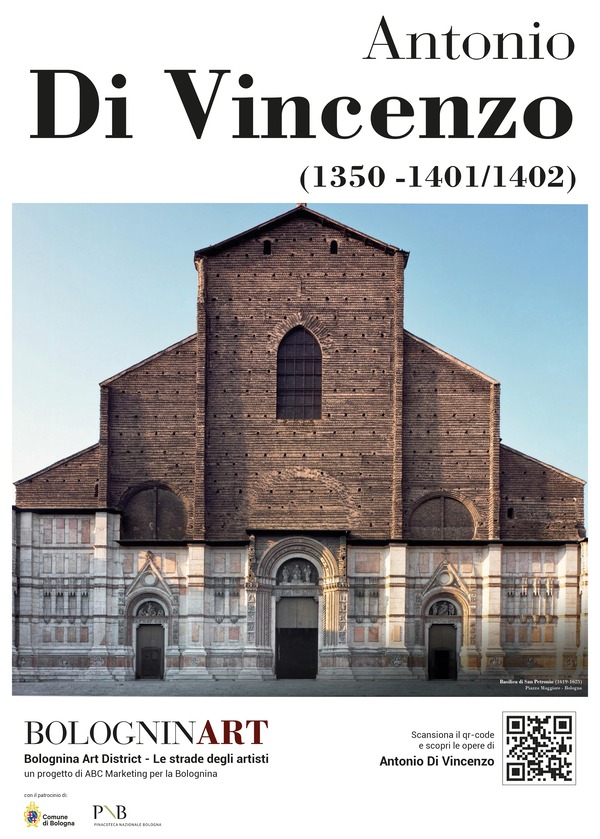
His fame must have been extremely high, as the Bolognese government, to celebrate their liberation from the Visconti, decided to entrust him with the construction of the new great church dedicated to St. Petronius, intended to compete with Santa Maria del Fiore in Florence and the Cathedral of Milan. On June 3, he was appointed master builder of the San Petronio construction, thanks to his “highly qualified preparation,” and four days later, he laid the first stone. It was indeed an arduous task, considering that in just four months, a vast area had been expropriated, and buildings such as houses, towers, and churches in that area had been demolished.
Artist’s Panel
Via Di Vincenzo, Bologna