Via Giovanni Francesco Barbieri
The street connecting Via di Corticella to Via Piero Gobetti in the Bolognina district of Bologna was opened in the post–World War II period and is dedicated to Giovanni Francesco Barbieri, better known as Il Guercino, a renowned painter of the Italian Baroque.
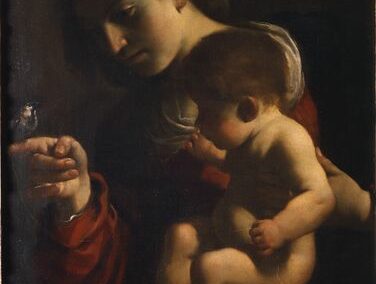
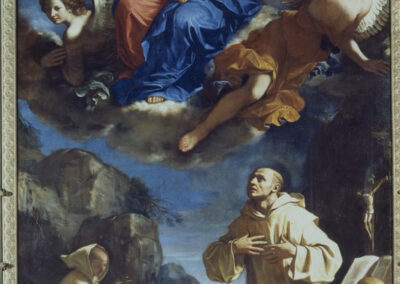
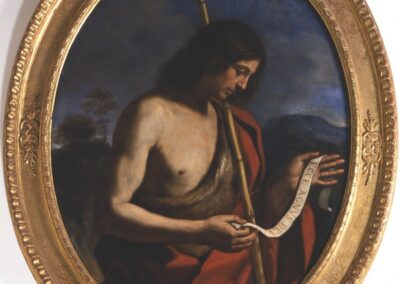
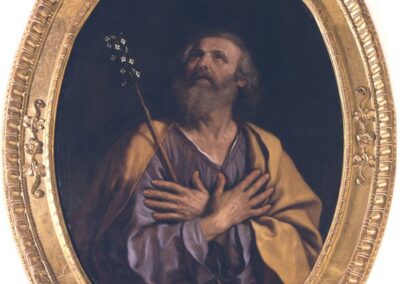
The works of Giovanni Francesco Barbieri:
Giovanni Francesco Barbieri, detto il Guercino
(1591-1666)
The nickname Guercino immortalized the figure of Giovanni Francesco Barbieri, enveloping him in a sort of myth. According to legend, the painter developed strabismus due to a fright he suffered in early childhood.
Historical sources reveal Guercino’s humble origins: born in 1591 to Andrea Barbieri and Elena Ghisellini, he came from a family that, according to biographer Calvi, “lived among the peasants… in a small house outside of Cento,” in the Ferrara region, a quiet and industrious area of the Po Valley, also home to painters like Garofalo and Dossi. From them, Guercino inherited a deep sensitivity toward nature and landscape. Noteworthy in Cento are the decorations of Casa Pannini, featuring bucolic scenes alongside mythological episodes.
A pivotal moment in his artistic development was encountering the work of Ludovico Carracci—particularly the Sacra Famiglia con San Francesco, painted in the very year of Guercino’s birth for the Capuchin church of Cento. According to Malvasia, Guercino called it his “cara cinna” (beloved cradle), a source of life and inspiration.
Carracci, in turn, admired Guercino and praised him in a letter to scholar Ferrante Carli, calling him a “draftsman and extraordinarily gifted colorist, a marvel of nature and a miracle capable of astonishing anyone who sees his works.” As Guercino’s fame grew, he founded a workshop that operated like an enterprise and introduced a fundamental educational tool: the Libro dei Disegni (Book of Drawings), presenting models for students to follow.
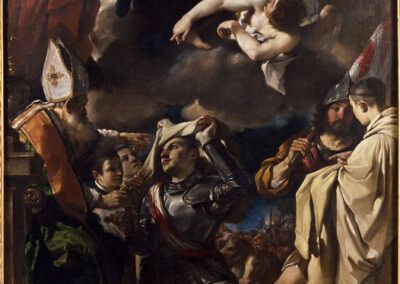
In 1618, Guercino visited Venice and, influenced by the refined painting of Titian, began to explore color as a powerful means of expression and interpretation. He conveyed theatrical grandeur in sacred subjects like the Vestizione di San Guglielmo and San Francesco in estasi, and a quiet allegorical intimacy in Et in Arcadia ego.
In 1621, Cardinal Alessandro Ludovisi—already a patron of Guercino in Bologna and now Pope Gregory XV—summoned him to Rome to paint the fresco cycle at the Casino dell’Aurora. The commission harnessed an intense pictorial energy that overflowed into his Sepoltura di Santa Petronilla for Saint Peter’s Basilica, a canvas of such colossal dimensions that the painter Lanfranco declared, “that painting alone could terrify any artist.”
Tempered by his Roman experience, Guercino returned to his homeland, where his workshop activity intensified, as documented in the Libro dei Conti—his ledger and organizational tool. He now enjoyed international fame, evidenced by a visit from Queen Christina of Sweden and even a job offer from Louis XIII of France. Nonetheless, Guercino remained in Emilia, producing masterpieces such as Apparizione di Cristo alla Madre (1628), emotionally impactful, and the frescoes of the Piacenza Cathedral dome (1627), praised by Goethe in his Italian Journey for their modernity.
In 1642, following the death of Guido Reni, Guercino moved to Bologna, receiving numerous commissions. His San Francesco (1648), painted for the church of San Giovanni in Monte, expresses profound restlessness and emotional depth. In his later Bolognese period, however, his style embraced the formal codes of the Maniera, visible in the grand altarpieces like San Gregorio (San Paolo) and San Filippo Neri (Santa Maria di Galliera, both 1647), and later in Santa Teresa (1660–1661, Carmelite Convent) and San Tommaso d’Aquino (1662–1663, San Domenico).
His fame in Bologna was sealed by the altarpiece Madonna con Bambino e San Bruno, which reflects the thoughtful solemnity of a mature artist, admired for his wisdom and humility—honored, but never intoxicated by glory.
Guercino died in 1666, reportedly of a heart attack, and was buried in the church of SS. Salvatore in Bologna, where a simple gravestone still marks his resting place.
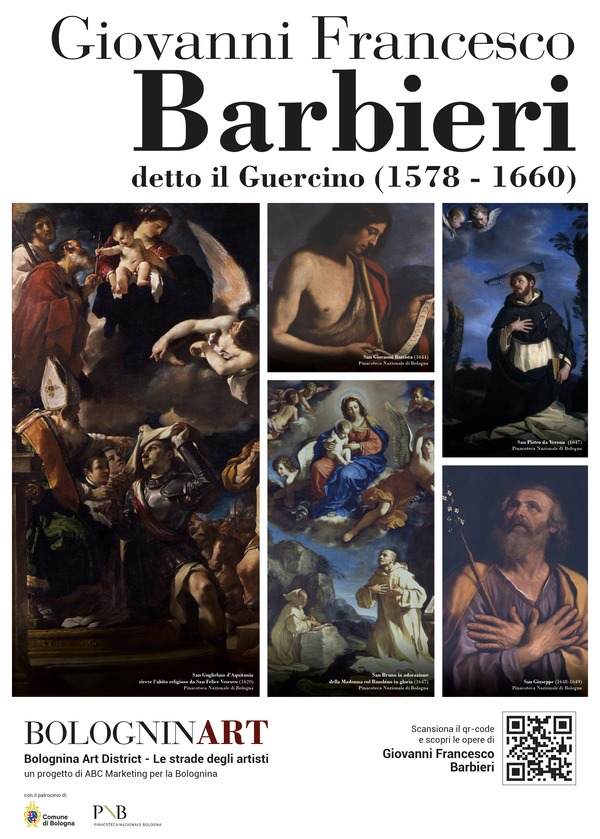
Artist’s Panel
Via Pellegrino Tibaldi, Bologna